
Your CIBIL score is the single most scrutinised number in your credit card application. It is the first thing a bank checks, the primary filter for approval decisions, and the key determinant of the credit limit and card variant you receive. Yet despite its importance, many applicants remain unclear about what score is actually needed, whether there is a fixed minimum, and what options exist when the score falls short.
This guide covers everything you need to know: what CIBIL score is required for a credit card in India, how different banks assess your score, what card categories become accessible at different score levels, and what you can do if your score is low or you have no credit history at all.
What Is the Minimum CIBIL Score for a Credit Card?
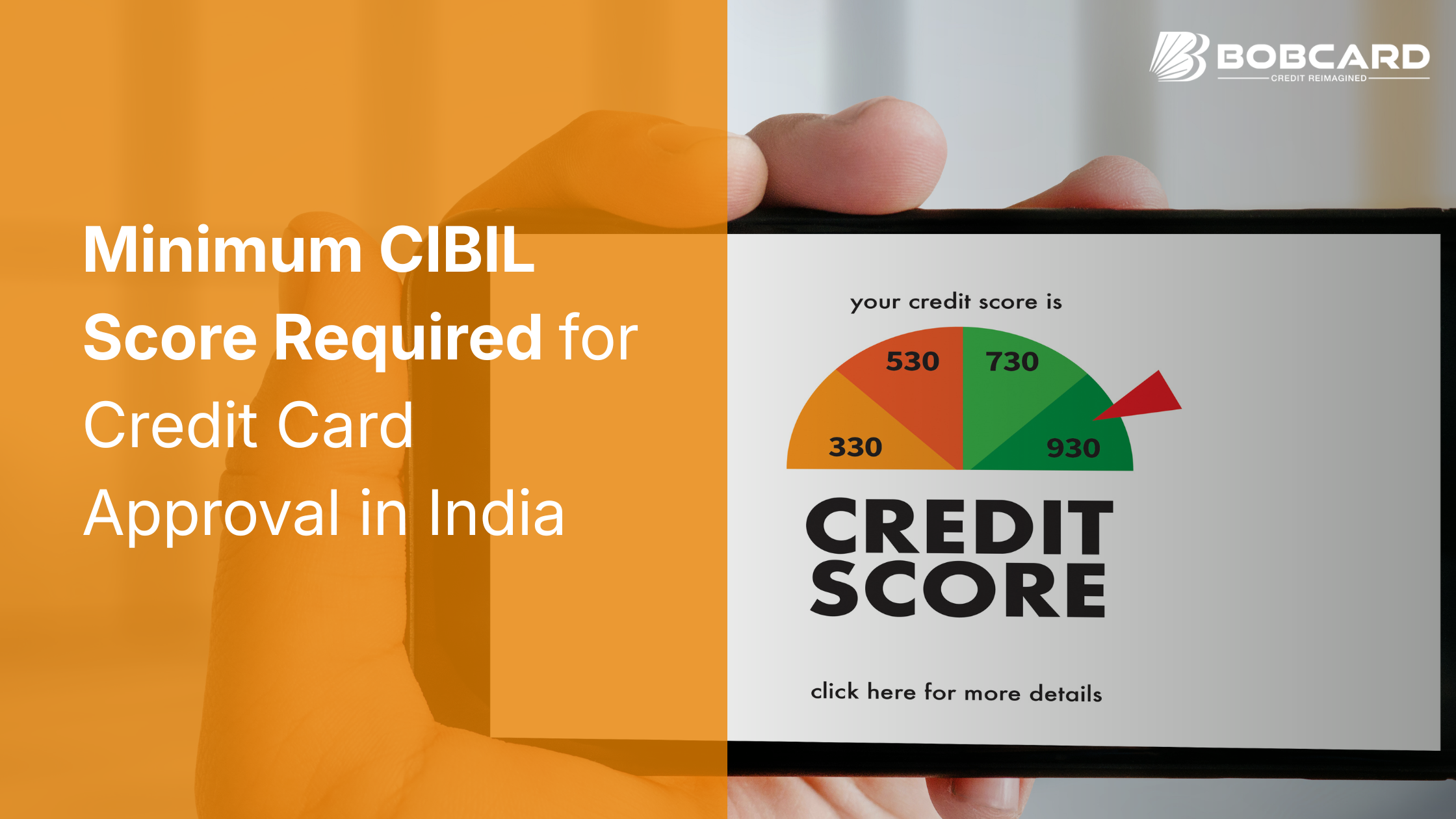
India's CIBIL score ranges from 300 to 900. There is no single, universally mandated minimum CIBIL score for credit card approval, each bank sets its own thresholds, which are applied alongside other factors such as income, employment stability, and existing debt obligations.
That said, the industry-wide benchmark is well-established:
- 750 and above: Considered excellent. Most banks will approve your application readily and offer their best card variants, highest credit limits, and lowest interest rates.
- 700–749: Considered good. Approval is likely for standard and mid-range cards, though premium products may require additional scrutiny.
- 650–699: Considered fair. Approval is possible but not guaranteed. Secured credit cards (against a Fixed Deposit) are the most accessible option at this range.
- Below 650: Considered poor. Unsecured credit card approval is very difficult. Secured cards against an FD or add-on cards under a family member's account are the primary alternatives.
Key insight: A score of -1 or NH (No History) means you have no credit record at all. This is different from a poor score and can actually be easier to work with, banks may approve FD-backed or salary-account-linked cards for first-time applicants.
Bank-Wise Minimum CIBIL Score for Credit Card
SBI Credit Card Minimum CIBIL Score
SBI Card, one of India's largest credit card issuers, generally requires a minimum CIBIL score of around 750–760 for standard unsecured credit card approval. Applicants with scores in the 700–750 range may still be considered based on income, employer profile, and banking relationship, though approval is not guaranteed.
HDFC Credit Card Minimum CIBIL Score
HDFC Bank, India's leading private sector credit card issuer, typically prefers a CIBIL score of 750 or above for its unsecured credit cards. However, the bank has been known to approve applicants with scores in the 700–749 range, particularly those with salary accounts or long-standing banking relationships with HDFC. Entry-level secured cards are available for scores below this threshold.
ICICI Credit Card Minimum CIBIL Score
ICICI Bank generally considers applicants with CIBIL scores of 700 and above for its standard credit card range. For premium and co-branded cards, a higher score, typically 750 or above, is preferred. ICICI also offers secured credit cards against a Fixed Deposit for applicants with lower scores or no credit history.
Axis Bank Credit Card Minimum CIBIL Score
Axis Bank is reported to require a minimum CIBIL score of around 700–736 for its entry and mid-level credit cards. Applicants with existing Axis Bank savings or salary accounts may receive more favourable consideration. Premium card products from Axis typically require scores of 750 or above.
BOB Credit Card Minimum CIBIL Score
Bank of Baroda credit cards, offered under the BOBCARD brand, generally follow the industry-standard benchmark of 700 and above for credit card approval. A score of 750 or above significantly improves both approval probability and the credit limit offered. BOBCARD also offers secured credit card options for applicants with limited or no credit history. Specific eligibility criteria should be verified at bobcard.in or at the nearest Bank of Baroda branch.
| Bank | Preferred CIBIL Score | Notes |
|---|---|---|
| SBI Card | 750–760+ | Strong score needed; relationship can help |
| HDFC Bank | 750+ | 700–749 possible with salary account |
| ICICI Bank | 700+ | 750+ for premium cards |
| Axis Bank | 700–736+ | Flexible for existing account holders |
| BOBCARD | 700+ | 750+ recommended for higher limits |
Note: These are indicative benchmarks based on publicly available information. Actual approval decisions depend on multiple factors beyond CIBIL score. Always verify with the issuing bank.
CIBIL Score Required by Credit Card Category
Minimum Score for Entry-Level Credit Cards
Entry-level credit cards, with modest annual fees (nil to ₹500), basic reward programmes, and credit limits typically in the ₹20,000–₹75,000 range, are the most accessible for applicants with lower scores. Many issuers approve entry-level cards for scores in the 650–700 range, particularly for applicants with stable income and salary account relationships with the bank.
Minimum Score for Rewards & Cashback Credit Cards
Rewards and cashback-focused credit cards, mid-range products with annual fees of ₹500–₹2,500 and more structured benefits, typically require a CIBIL score of 700 or above. A score of 750+ significantly improves the chances of approval and the attractiveness of the offer (higher limits, better reward rates).
Minimum Score for Premium & Super Premium Credit Cards
Premium credit cards, those with airport lounge access, comprehensive travel benefits, lifestyle privileges, and annual fees of ₹2,500–₹10,000, typically require a CIBIL score of 750 or above and a minimum annual income of ₹6–₹12 lakh. Super-premium cards (annual fees of ₹10,000+) generally require scores of 800+ and significantly higher income thresholds.
Minimum Score for Travel Credit Cards
Travel credit cards, co-branded airline cards, cards with accelerated miles earning, and products with international lounge access, are positioned in the mid-to-premium range. Most require a score of 700–750 at minimum, with preferred scores of 750+ for the best variants. First-time travellers with strong income but limited credit history may be considered on a case-by-case basis.
Can You Get a Credit Card with a Low CIBIL Score?
Yes, though your options are more limited. Here is what is available at each score level:
- Secured credit cards (against an FD): The most accessible option. You deposit a fixed amount with the bank, which acts as collateral. The credit limit is typically 75%–90% of the FD value. No credit score requirement, and your FD continues to earn interest. Available from most major banks.
- Salary-account-linked cards: If you have your salary credited to the issuing bank and maintain a healthy account, some banks may approve a credit card based on your account behaviour, salary consistency, transaction history, rather than your CIBIL score alone.
- Add-on card under a family member's account: Becoming an authorised user on a parent's or spouse's credit card gives you access to credit without an independent score requirement, while also helping you build your own credit history through association.
- Entry-level cards with lenient criteria: Some NBFCs and digital lending platforms offer entry-level credit cards with more flexible score requirements, particularly for young professionals with limited credit history but demonstrated income stability.
Can You Get a Credit Card with No CIBIL Score?
A score of -1 or NH (No History) means you have no credit record, which is different from having a bad score. First-time borrowers, recent graduates, and individuals who have never taken a loan or held a credit card fall into this category.
Banks handle this profile in one of two ways: they either decline the application (since there is no data to assess risk) or they approve a limited product, typically a secured FD-backed card or a salary-account-linked card, at a conservative credit limit.
The most effective strategy for a no-history applicant is to start with a secured credit card or add-on card, use it for small regular purchases, pay the bill in full every month, and allow 6–12 months of positive behaviour to generate a CIBIL score. Once a score above 700 is established, upgrading to an unsecured card becomes straightforward.
Ready to Explore? Apply for BOBCARD Today.
Whether you are building your credit profile from scratch or looking to upgrade to a card that rewards a strong CIBIL score, BOBCARD, from Bank of Baroda, offers credit card options across the eligibility spectrum. Explore secured and unsecured BOBCARD variants designed for every stage of your credit journey.
Apply now at bobcard.in or visit your nearest Bank of Baroda branch.
Frequently Asked Questions
Disclaimer
This blog is for general educational and informational purposes only and does not constitute financial or legal advice. CIBIL score benchmarks referenced in this article are indicative industry estimates based on publicly available information as of the date of publication. Actual credit card approval decisions are made at the sole discretion of the issuing bank and depend on the applicant's complete financial and credit profile. TransUnion CIBIL is a trademark of TransUnion CIBIL Limited. BOBCARD is a product of Bank of Baroda, an RBI-regulated entity. Readers are advised to verify current eligibility criteria directly with BOBCARD and their respective banks.