
Table of Contents
- 1.Minimum Age Requirement for Student Credit Card
- 2.Eligibility Criteria for Student Credit Card in India
- 3.How Can Students Get a Credit Card Without Income?
- 4.Best Credit Cards for Students in India
- 5.Benefits of Getting a Credit Card as a Student
- 6.Risks Students Should Know Before Getting a Credit Card
- 7.Tips for Students Using a Credit Card for the First Time
Getting a credit card as a student in India is not as straightforward as it is for a salaried professional, but it is entirely possible, and starting your credit journey early is one of the smartest financial decisions you can make. A credit card obtained and managed responsibly during your college years can give you a head start on building a CIBIL score, establish financial discipline, and give you access to emergency funds without relying on your parents every time.
The challenge is that most standard credit cards require a stable income, something most students do not have. However, banks have structured alternative pathways specifically for students: secured credit cards backed by Fixed Deposits, add-on cards under a parent's account, and a small number of entry-level cards designed for first-time applicants without income proof. This guide explains every option in detail, including what to expect, what documents you need, and how to use your first credit card wisely.
Minimum Age Requirement for Student Credit Card
As per RBI guidelines and standard banking practice in India, the minimum age to apply for a credit card in your own name is 18 years. Below this age, you cannot be a primary credit cardholder, primarily because a credit card agreement is a legal contract, and individuals under 18 are not considered legally competent to enter into binding financial contracts in India.
For students aged 18 to 21, the typical college-going bracket, credit card options are available but more limited than for older, employed applicants. The most accessible routes for this age group are FD-backed secured cards, add-on cards under a family member's account, or student-specific products from select banks and NBFCs.
Eligibility Criteria for Student Credit Card in India
Age Eligibility, Minimum 18 Years
The legally mandated minimum age for a primary credit cardholder in India is 18 years. Most banks set their minimum age at 18 and apply an upper age limit of 60–65 years for standard credit card products. For add-on cards under a parent's account, some banks allow the supplementary cardholder to be younger, verify the bank's specific policy.
Income Requirement, Salaried vs Non-Earning Students
This is where students face the primary hurdle. Standard unsecured credit cards require a stable monthly income, most banks have minimum thresholds of ₹15,000–₹25,000 per month. Most full-time students do not meet this criterion.
However, there are structured alternatives that do not require income proof:
- FD-backed secured credit cards: No income proof required. The Fixed Deposit acts as collateral.
- Add-on cards: No income requirement for the supplementary cardholder, the primary account holder's income qualifies the account.
- Part-time income/internship: Students with a part-time job or stipend above the bank's minimum threshold may qualify for entry-level unsecured cards. Salary slips, bank statements, or an offer letter from the employer are typically required.
CIBIL Score Requirement for First-Time Applicants
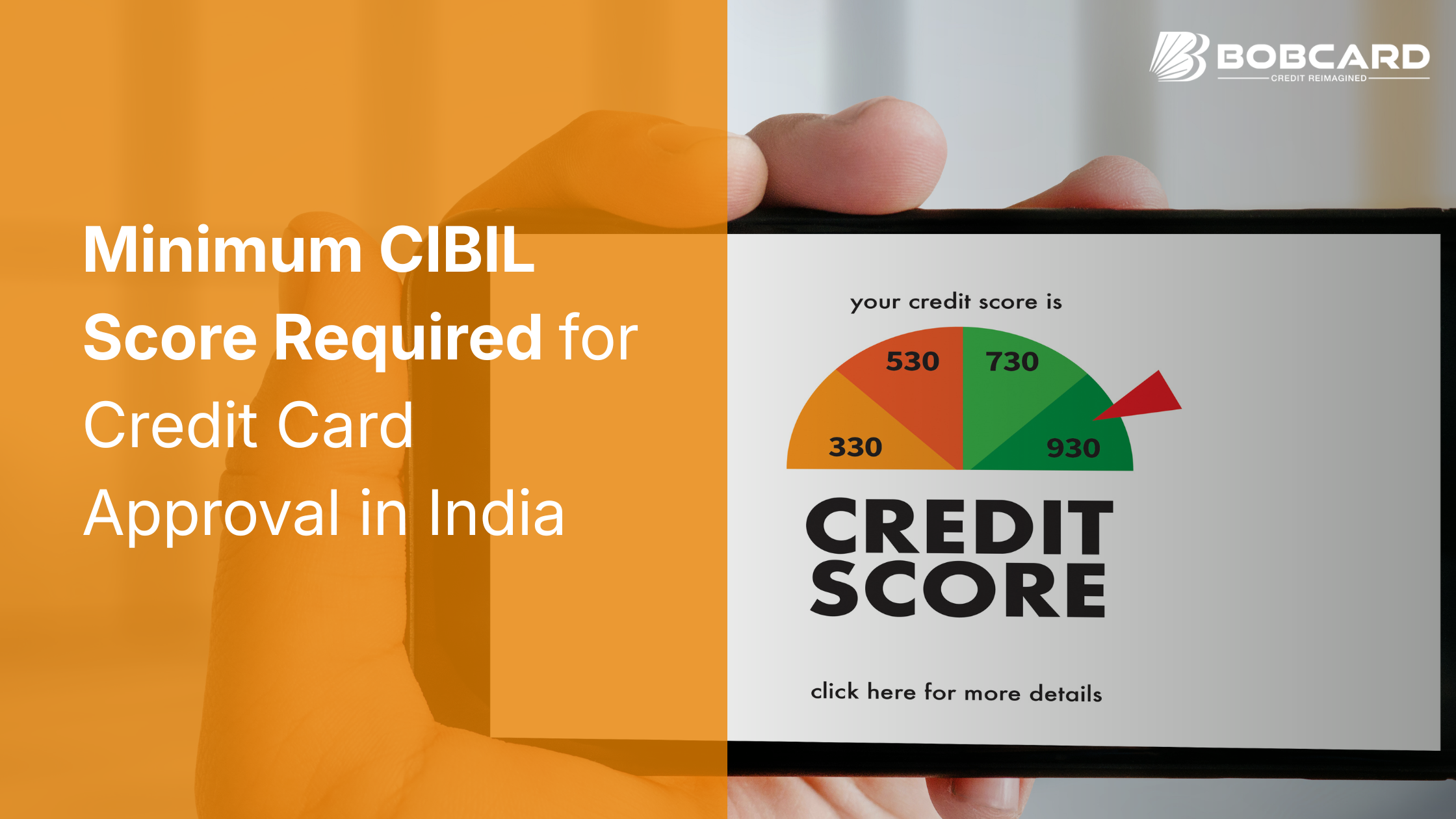
Most students applying for their first credit card have no CIBIL score, which is recorded as -1 or NH (No History). This is not a bad score; it simply means there is no credit history to assess. Banks handle this in one of two ways: they decline unsecured applications due to insufficient data, or they approve FD-backed or account-linked cards at conservative limits. A no-history profile is, in fact, easier to work with than a poor score, it carries no negative track record.
Documents Required to Apply
- Identity Proof: Aadhaar Card, PAN Card, Passport, or Voter ID
- Address Proof: Aadhaar Card, Passport, or utility bill in the applicant's name
- Student/Enrollment Proof: College ID card, admission letter, or fee receipt (for student-specific cards)
- FD Account Details: Account number and FD certificate (for secured cards)
- Income Proof (if applicable): Last 3 months' salary slips, bank statement, or offer letter (for students with part-time income)
- Passport-size photographs
How Can Students Get a Credit Card Without Income?
Secured Credit Card Against Fixed Deposit
- The most reliable and widely available credit card option for students without income is a secured credit card backed by a Fixed Deposit. Here is how it works:
- You open a Fixed Deposit with a bank, the minimum FD amount typically ranges from ₹5,000 to ₹25,000 depending on the bank.
- The bank issues a credit card with a limit equal to 75%–90% of the FD value (some banks offer up to 100%).
- The FD continues to earn interest as usual. It simply acts as collateral for the credit card account.
- No income proof, no credit history, and no CIBIL score are required.
Add-On Credit Card Under Parent's Account
If a parent or guardian already holds a credit card, they can apply for a supplementary (add-on) card for their child. The add-on card is issued in the student's name, linked to the parent's credit account. Key points to understand:
- The credit limit of the add-on card is shared with the primary card's total limit.
- All transactions are billed to the primary cardholder, the parent remains financially responsible for repayment.
- The student's usage (if reported by the bank) can contribute to building their credit profile.
- No income, CIBIL score, or independent eligibility is required from the add-on cardholder.
This is often the simplest and fastest option for students who need immediate access to a card, as it does not require setting up a new FD account.
Credit Card Against Scholarship or Stipend Income
Students receiving a regular scholarship, fellowship stipend, or research grant that is credited monthly to their bank account may be eligible for entry-level credit cards at banks that accept non-salary income as qualifying income. The monthly credit to the account, if consistent and above the minimum income threshold, can serve as evidence of repayment capacity. Bank statements showing regular credits over 3–6 months are typically the required proof.
Student Credit Cards with No Income Proof Required
A small number of banks and NBFCs in India offer credit cards specifically designed for college students without requiring income proof. These typically require proof of enrollment in a recognised educational institution and a PAN card. Credit limits on these cards are low, usually ₹10,000–₹50,000, and annual fees are minimal or nil. These cards are designed to introduce students to responsible credit usage and help them build a CIBIL score before entering the workforce.
Best Credit Cards for Students in India
Best Secured Credit Card for Students
FD-backed secured credit cards from IDFC FIRST Bank (FIRST WOW!), ICICI Bank (Instant Platinum), and Kotak Mahindra Bank (811 DreamDifferent) are widely regarded as the best-structured student credit card options. All three carry zero joining and annual fees, require no income proof or CIBIL score, and offer credit limits linked to the FD amount (75%–100%). The IDFC FIRST WOW! card additionally offers zero forex markup, useful for students in internationally linked programmes or those studying abroad.
Best Entry-Level Credit Card for First-Time Applicants
Students with a part-time income or internship stipend above ₹15,000 per month may qualify for standard entry-level credit cards from banks like SBI (SimplySAVE), HDFC (MoneyBack+), or ICICI (Coral). These cards carry minimal annual fees (₹500–₹1,000), offer basic reward programmes, and are specifically designed for first-time cardholders with limited credit history.
Best No-Fee Credit Card for Students
For students who want the benefits of a credit card without any fee commitment, FD-backed lifetime-free cards are the best option. The IDFC FIRST WOW!, ICICI Instant Platinum, and Kotak 811 DreamDifferent are all lifetime-free (no joining fee, no annual fee) and accessible without income proof or prior credit history.
Best Credit Card for Students for Online Shopping & OTT
Students who spend primarily on e-commerce, food delivery, and entertainment subscriptions should look for entry-level cards with accelerated cashback or reward points on online transactions. Several entry-level cards offer 5%–10% cashback on platforms like Amazon, Swiggy, Zomato, Flipkart, and for OTT subscriptions. Compare the monthly cashback cap and the minimum spend required before choosing a card for this use case.
Benefits of Getting a Credit Card as a Student
Build Credit History & CIBIL Score from an Early Age
Starting your credit journey at 18–22 means you will have 2–4 years of positive credit history by the time you enter the job market. A CIBIL score of 750+ built during college years is a significant advantage when applying for a home loan, car loan, or premium credit card as a young professional. The earlier you start building responsibly, the stronger your credit foundation.
Emergency Fund Backup Without Asking Parents
A credit card provides a financial safety net for genuine emergencies, an unexpected medical expense, a missed connection on a trip, a sudden repair, without requiring you to call home. Used appropriately, this independence is empowering and practical, particularly for students studying away from home.
Cashback & Discounts on Food, Travel & Shopping
Student spending patterns, food delivery apps, online shopping, movie tickets, travel, are precisely the categories where many entry-level credit cards offer cashback and discounts. With disciplined usage (staying within budget and paying the full bill), a student can realistically earn ₹300–₹1,000 per month in rewards on their regular spending.
Learn Financial Discipline Early
Managing a credit card, tracking your spending, understanding the billing cycle, paying bills on time, is one of the most practical financial education experiences available. Students who develop these habits early are significantly better prepared to manage more complex financial products, loans, investments, insurance, as they move through life.
Risks Students Should Know Before Getting a Credit Card
Risk of Overspending Beyond Repayment Capacity
The biggest risk for student cardholders is spending beyond what they can repay by the due date. A credit card limit can feel like 'free money', it is not. Any balance not paid in full by the due date attracts interest at 24%–48% per annum, turning a small purchase into a growing debt. Set a self-imposed monthly spending cap well below your actual credit limit and treat it as an absolute ceiling.
Missing Due Dates Can Damage Credit Score Early
A single missed payment can reduce your CIBIL score by 50–100 points and remain on your credit report for up to 7 years. For a student who is building their score from scratch, this is a disproportionately damaging setback. Set up auto-pay for at least the minimum due amount, and aim to pay the full outstanding balance, so you never miss a due date inadvertently.
High Interest on Unpaid Balances
Credit card interest rates in India range from 24% to 48% per annum, among the highest interest rates in the consumer lending market. A ₹5,000 balance left unpaid for 6 months can grow to over ₹6,200 at a 40% annual rate. Students on limited income should be especially careful to treat credit card spending as a deferred payment, not a line of credit to revolve.
Tips for Students Using a Credit Card for the First Time
Always Pay Full Outstanding, Not Just Minimum Due
The minimum due is the smallest amount the bank will accept to keep your account in good standing, it does not prevent interest from accruing on the remaining balance. Always aim to pay your full outstanding balance. If that is not possible in a given month, pay as much above the minimum due as you can and prioritise clearing the balance the following cycle.
Keep Credit Utilisation Below 30%
Credit utilisation, the percentage of your credit limit you are using, accounts for approximately 25%–30% of your CIBIL score. Keeping this ratio below 30% signals responsible usage. On a ₹20,000 credit limit, that means keeping your outstanding balance below ₹6,000 at any time. This single habit, maintained consistently, will build your CIBIL score meaningfully over 6–12 months.
Set Auto-Pay to Never Miss a Due Date
Enable auto-pay from your savings account for at least the minimum due amount each billing cycle. This eliminates the risk of missing a due date due to forgetfulness or being busy with exams. Once auto-pay is set, you can manually pay more whenever your account allows, but you are protected from the worst outcome (a missed payment damaging your score) automatically.
Start with a Low Credit Limit Card
Beginning with a card with a low credit limit is a feature, not a drawback. A lower limit naturally caps your spending exposure, reduces the risk of overspending beyond your means, and encourages you to build disciplined habits before more credit is extended to you. As your score and income grow, the limit can be enhanced, but starting conservatively is the financially prudent approach.
Ready to Explore? Apply for BOBCARD Today.
BOBCARD, powered by Bank of Baroda, offers credit card solutions accessible to applicants at every stage of their financial journey, including first-time applicants and students building their credit profile. Explore BOBCARD's range and find a card that matches where you are today.
Frequently Asked Questions
Disclaimer
This blog is for general educational and informational purposes only and does not constitute financial or legal advice. Eligibility criteria, minimum income thresholds, FD requirements, and card features referenced in this article are based on publicly available information as of the date of publication and are subject to change without notice. Students are advised to verify current eligibility criteria directly with the relevant bank before applying. BOBCARD is a product of Bank of Baroda, an RBI-regulated entity. Government-backed student credit card schemes (Bihar Student Credit Card, West Bengal Student Credit Card) are state government programmes with their own separate eligibility criteria; readers should refer to official government sources for details.