
Age is the first eligibility filter in any credit card application in India. Before income, before credit score, before employment status, the bank needs to know whether you are legally old enough to enter into a financial contract. Understanding the minimum age requirement, how it varies between banks, and what your options are if you are under the standard threshold will save you from wasted applications and unnecessary CIBIL inquiries.
This guide covers the minimum age to apply for a credit card in India, the rules for primary and add-on cardholders, BOBCARD's specific age criteria, and how students and young adults can start building credit before they qualify for a standard card.
What Is the Minimum Age to Apply for a Credit Card in India?
The legal minimum age to apply for a credit card in India is 18 years. Under the Indian Majority Act of 1875, a person becomes legally competent to enter into a binding contract, including a credit card agreement, at 18. Since a credit card is a legal contract between the cardholder and the issuing bank, 18 is the constitutional floor below which no bank can issue a primary card.
However, the legal minimum and the practical minimum are often different. Many banks in India set their own internal minimum at 25 years for primary unsecured credit cards, particularly for applicants who are salaried.
RBI Guidelines on Credit Card Age Eligibility
The Reserve Bank of India does not prescribe a specific minimum age for credit card issuance beyond what follows from general contract law. The Indian Contract Act, 1872, makes contracts with minors void, meaning no valid credit card agreement can be entered with a person below 18. Beyond this, the RBI's Master Direction on Credit Card and Debit Card, Issuance and Conduct Directions leaves the specific age threshold to individual banks and NBFCs, requiring only that they follow responsible lending practices.
The RBI does require banks to clearly disclose all credit card terms, including age eligibility criteria, in the Most Important Terms and Conditions (MITC) document provided to applicants. RBI guidelines also require that banks not issue credit cards to individuals they deem unable to service the debt, which is a practical reason banks set the minimum at 21 for income-dependent unsecured cards.
Minimum Age for Primary Credit Cardholder
For a primary credit card, a card issued in your name with your own credit limit and your personal liability, the minimum age in India is 18 years as a legal floor. In practice, most major banks apply the following age standards:
| Bank / Issuer | Min. Age for Primary Card | Max. Age (Indicative) | Notes |
|---|---|---|---|
| BOBCARD (Bank of Baroda) | 25 years | 55–65 years | Age 25 required for flagship cards |
| HDFC Bank | 21 years | 60 years (salaried) | Varies by card variant |
| ICICI Bank | 21 years | 60 years | Student card: 18+ |
| SBI Cards | 21 years | 60–70 years | SBI extended limit to 70 on select cards |
| Axis Bank | 21 years | 60 years (salaried) | Self-employed: up to 65 |
| Kotak Mahindra Bank | 21 years | 65 years | Varies by segment |
| IDFC FIRST Bank | 21 years | 65 years | FD-backed: 18+ |
| General fintech/co-brands | 18 years | 60–65 years | App-based cards often from 18 |
*Age limits are indicative and vary by card variant, income category and bank policy. Always verify on the bank's official website before applying.
Minimum Age for Add-On or Supplementary Cardholder
An add-on card, also called a supplementary card, is a card issued for a family member of the primary cardholder. It draws from the same credit limit as the primary card, and the primary cardholder bears full liability for all spending on the add-on card.
Most banks in India set the minimum age for an add-on cardholder at 18 years. However, some banks go lower, particularly for cards issued by parents to their children. A few banks allow add-on cards for individuals as young as 15 to 16 years with the primary cardholder's consent. Some co-branded and fintech cards have allowed add-on cardholders from 13 years, but this is not standard practice among scheduled commercial banks.
Key rule: The primary cardholder is fully and legally responsible for all transactions on add-on cards, including unauthorised or accidental spending by younger add-on cardholders. There is no age below which the primary cardholder's liability is reduced.
BOBCARD's standard policy allows add-on cards for spouses, parents, siblings, and children above 18 years of age, up to 3 free add-on cards on most cards in the portfolio.
Age Eligibility Criteria for BOBCARD Credit Cards
BOBCARD, the credit card subsidiary of Bank of Baroda, has specific age criteria that vary by card. The following are verified from bobcard.co.in as of March 2026:
| BOBCARD Card | Minimum Age | Maximum Age | Category |
|---|---|---|---|
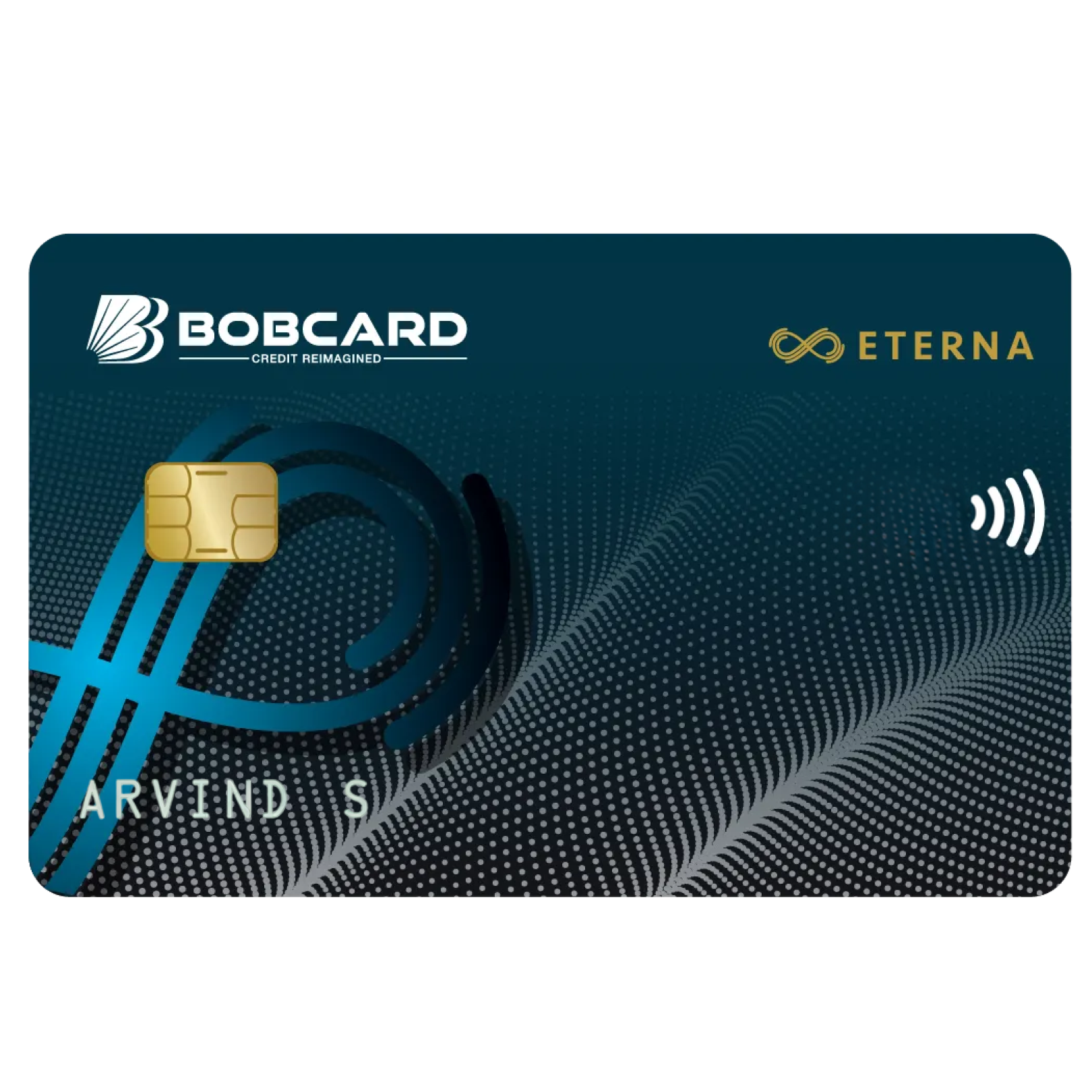
| BOBCARD ETERNA | 25 years | 55 years | Premium Lifestyle |
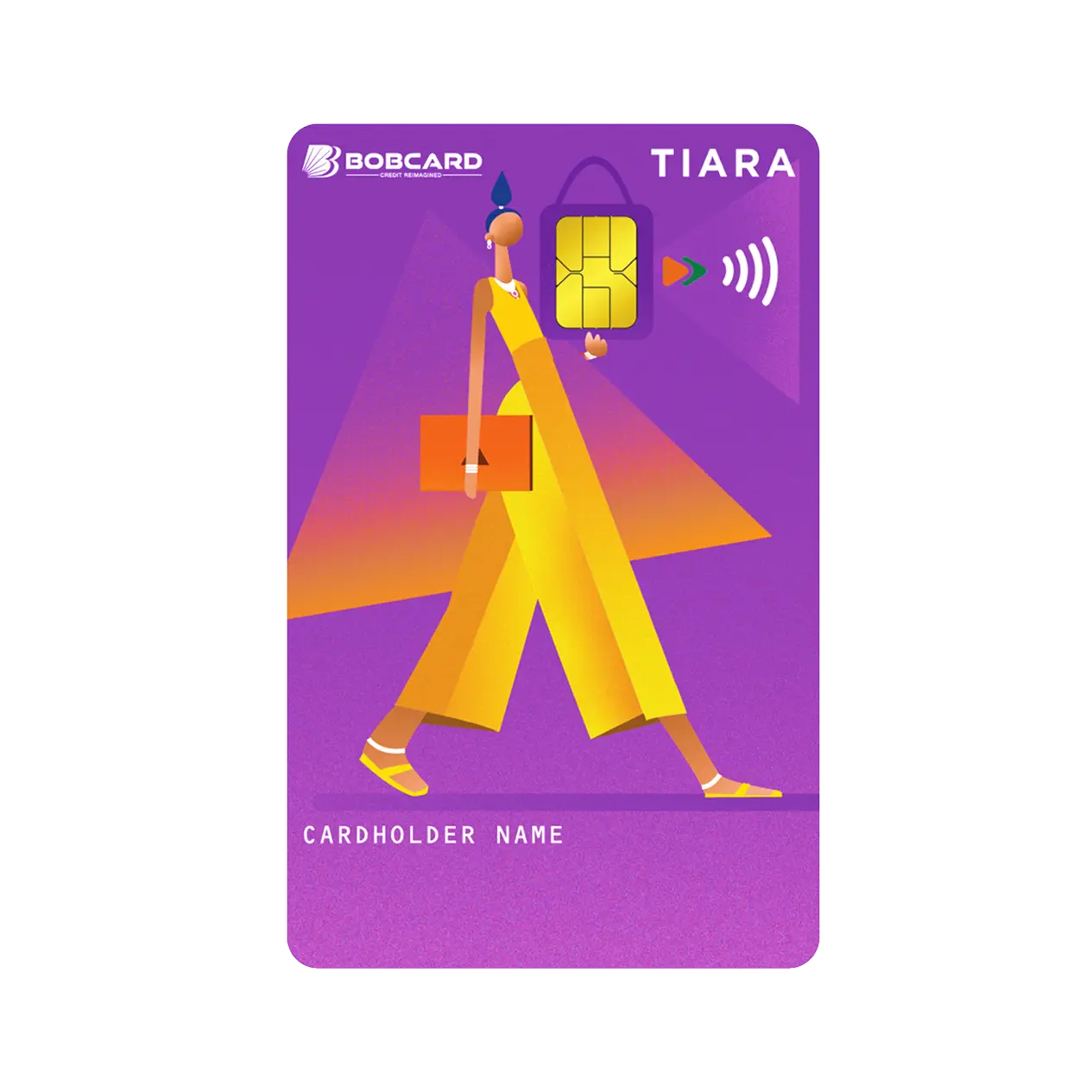
| BOBCARD TIARA | 25 years | 55 years | Women's Premium |
| BOBCARD PREMIER | 21 years (salaried) | 60 years (salaried) | Travel |
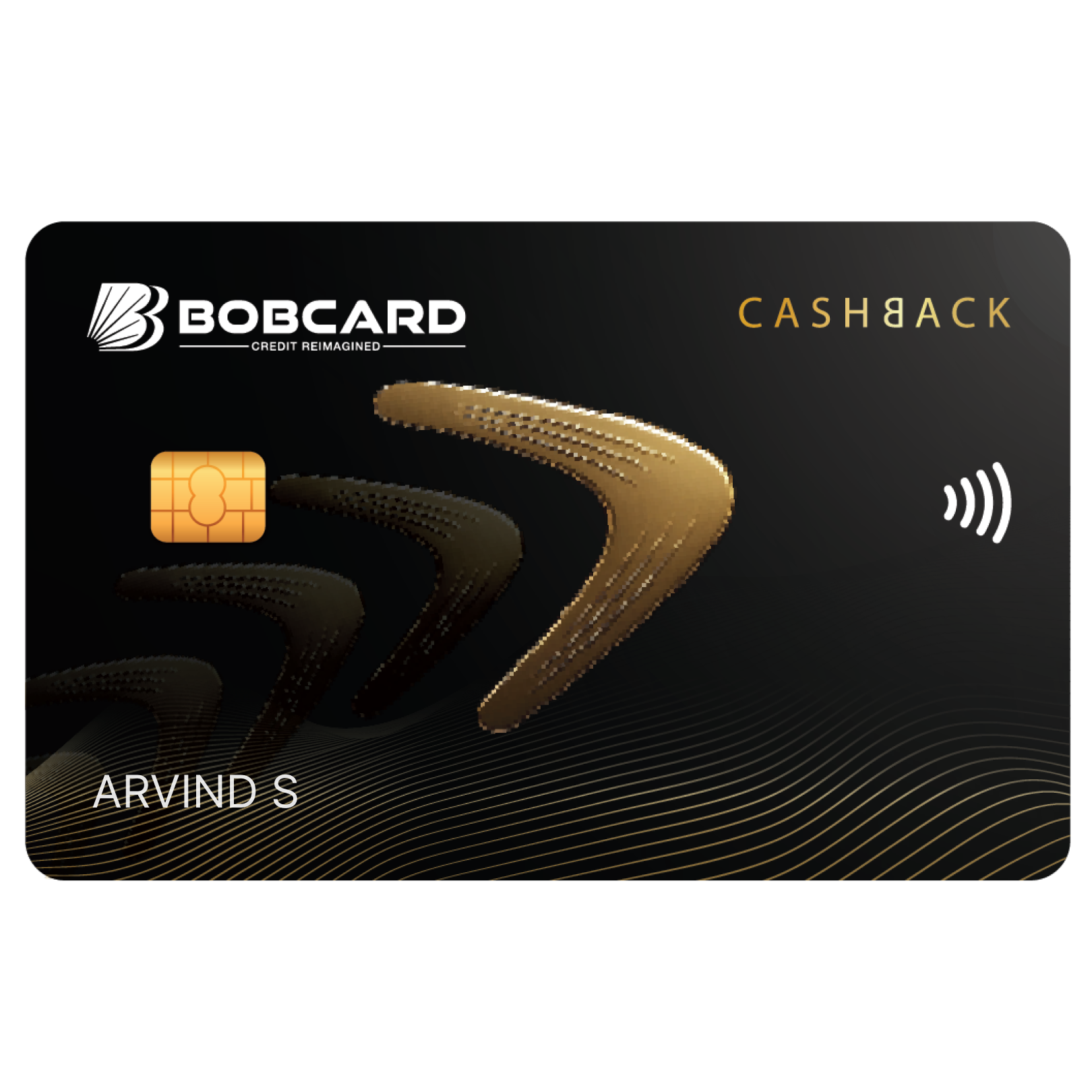
| BOBCARD Cashback | 25 years | 55 years | Cashback |
| BOBCARD SELECT | 25 years (salaried) | 65 years (self-employed) | Shopping/Rewards |
| BOBCARD PRIME | No minimum (FD-based) | No stated maximum | Secured/FD-backed |
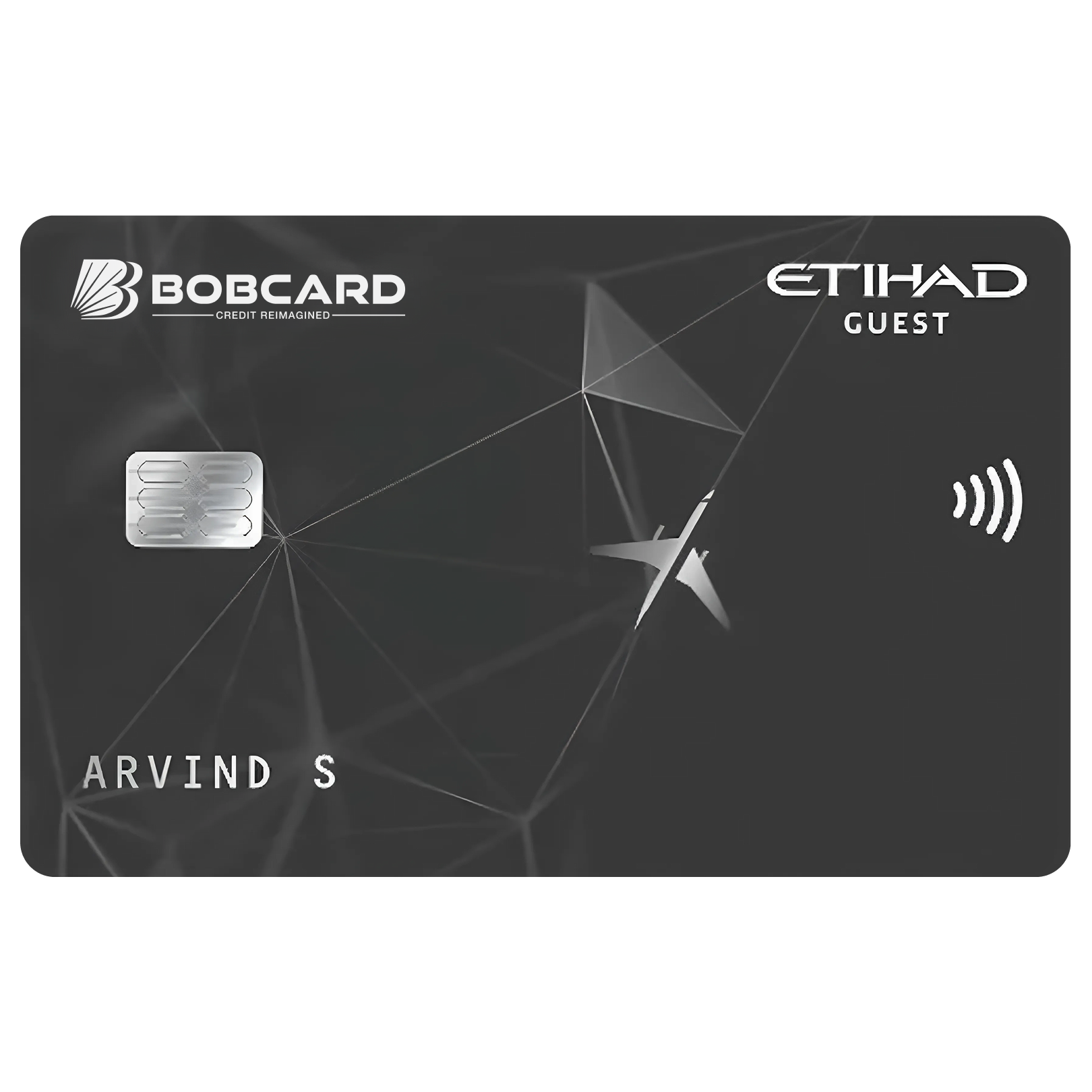
| Etihad Guest Premium | 25 years | 60 years | Airline Co-brand |
| Etihad Guest | 25 years | 60 years | Airline Co-brand |
| Add-on cards (all BOBCARD) | 25 years | As per primary cardholder's card terms | Supplementary |
*Verify current age criteria on bobcard.co.in before applying. BOBCARD may exercise discretion on age cut-offs for applicants marginally outside stated ranges.
The 25-year minimum on BOBCARD ETERNA and TIARA reflects their premium positioning, these cards are designed for established professionals with stable income. For applicants aged 21–24, BOBCARD PREMIER or BOBCARD Cashback are the appropriate starting points.
Other Eligibility Criteria to Apply for a Credit Card
Meeting the age requirement is the starting condition, but banks evaluate several other factors before approving a credit card application.
Minimum Income Requirement
Income is the primary basis on which a bank assesses your ability to repay credit card dues. Most banks have a minimum monthly income threshold for primary cardholders. For basic credit cards, the minimum is typically ₹15,000 to ₹25,000 per month (₹1.8–3 lakh annually) for salaried applicants. Mid-range cards require ₹25,000–₹50,000 per month. Premium cards start from ₹50,000–₹1 lakh per month or above.
BOBCARD Cashback is one of the most accessible cards on income, requiring ₹3.2 lakh net annual income for salaried applicants (approximately ₹26,667 per month). BOBCARD ETERNA and TIARA require ₹12 lakh and ₹7.2 lakh respectively. Secured (FD-backed) cards like BOBCARD PRIME have no minimum income requirement.
Employment Type: Salaried vs Self-Employed
Both salaried and self-employed individuals can apply for most credit cards in India. Salaried applicants are typically assessed on bank statement salary credits for the last 2–3 months and salary slips. Self-employed applicants are assessed on the basis of Income Tax Returns (ITR) filed for the previous 1–2 financial years, audited financials, and business registration proof.
Self-employed applicants often face a slightly higher income threshold and a more conservative initial credit limit because income can be irregular. Some banks also have a higher minimum age for self-employed applicants, for example, many banks set 24 years for self-employed versus 21 for salaried.
Minimum CIBIL Score Required
A credit score (CIBIL or equivalent) reflects your credit repayment history. For most standard unsecured credit cards, banks prefer a score of 700 or above. Mid-range and premium cards typically require 750 or above. A score of 750 or higher also improves your chances of a higher initial credit limit.
First-time applicants, including most young adults, have no credit score at all, which is different from a low score. A 'no score' or 'NH' (No History) profile is not a negative signal, but it makes banks cautious. This is one reason first-time applicants are often directed toward secured (FD-backed) cards, which do not require a credit history.
Valid KYC Documents Required
All credit card applications in India require KYC compliance. The standard documents required are:
● PAN Card, mandatory for all applicants. All credit card applications in India are linked to PAN for credit bureau reporting
● Identity Proof, Aadhaar Card, Voter ID, Passport, or Driving Licence
● Address Proof, Aadhaar Card, Utility Bill, Passport, Driving Licence, or Bank Account Statement
● Income Proof, for salaried: bank statements (last 2–3 months with salary credits); for self-employed: latest ITR with acknowledgement, or audited financial statements
● Recent passport-size photograph with a clear background
Most major banks, including BOBCARD, now complete KYC digitally, using Aadhaar-based e-Sign (OTP to Aadhaar-linked mobile) and Video KYC (a brief video call with a bank representative). No physical document submission or branch visit is typically required.
Minimum Age for Student Credit Card
Student credit cards are a specific product category designed for college students aged 18 and above who have no or very limited income. They typically carry:
● A low or zero credit limit (usually ₹10,000 to ₹30,000)
● No income requirement, or a very low threshold
● Either a parent as guarantor, or issuance against a small fixed deposit
● No annual fee or a nominal one, often ₹500 or below
● Basic rewards and cashback on everyday categories
The main purpose of a student credit card is not the rewards, it is the CIBIL score building. Using a student card responsibly for 12 to 18 months creates a positive credit history that makes the cardholder eligible for standard unsecured cards after graduation or once employment begins.
A few state governments have also launched student credit schemes, the West Bengal Student Credit Card Scheme and Bihar's Student Credit Card scheme offer education-linked credit at concessional rates to students for higher education costs. These are state government schemes, not private bank products, and have different application and eligibility processes.
Most banks issue student credit cards to applicants aged 18 and above. If you are 18 and enrolled in a recognised educational institution, you can apply for a student card with a parent guarantor, or for a secured credit card backed by a fixed deposit as small as ₹5,000 to ₹10,000.
BOBCARD PRIME, issued against a Bank of Baroda fixed deposit, is a practical option for students over 18 who want to start building a credit history. There is no income proof requirement, no credit history needed, and the card is lifetime free.
Can Someone Below 18 Get a Credit Card?
No. A person below 18 years of age cannot legally hold a credit card in their own name in India. Under the Indian Contract Act, 1872, a minor cannot enter into a binding legal contract, and a credit card agreement is a legal contract. Any credit card issued to a person below 18 would be void and unenforceable.
However, there is a practical way for under-18s to access a credit card: as an authorised add-on cardholder on a parent's or guardian's existing credit card account. In this arrangement, the minor receives a supplementary card linked to the parent's account. The parent's credit limit is shared, and the parent bears full legal and financial liability for all transactions.
Most banks allow add-on cardholders from age 18. A few private banks and fintech-backed cards allow add-on cardholders from 15 or 16, and some international programmes allow authorised users as young as 13, but this is uncommon among scheduled commercial banks in India. Always verify the specific add-on cardholder age policy of the issuing bank before proceeding.
From a financial education perspective, add-on cards can help teenagers learn to manage spending responsibly, with the parent having full visibility into transactions through the primary account. Setting a sub-limit on the add-on card, most banks allow this, is a practical way to introduce financial responsibility while controlling exposure.
Important: An add-on card on a parent's account does NOT build the child's own CIBIL score. Only a primary card held in your own name creates your credit history. To start building your own credit profile, you need to be 18 or above and hold a card in your own name.
Ready to Apply for Your First BOBCARD Credit Card?
BOBCARD, the credit card arm of Bank of Baroda, offers credit cards starting from ₹3.2 lakh annual income. Apply 100% online: form → Aadhaar eSign → Video KYC. No branch visit needed.
Whether you are 18 and looking for your first FD-backed card, a young professional wanting a cashback card, or an experienced cardholder upgrading to a premium product, BOBCARD has options across every income level and life stage.
Frequently Asked Questions
Disclaimer: This article is for general informational and educational purposes only. Age limits, income requirements and credit card features vary by bank and are subject to change without notice. Always verify current requirements directly with the bank or card issuer before applying. Eligibility, fees and card features are subject to BOBCARD's terms and conditions. Verify current details at bobcard.co.in before applying.